DevDays 09 in Portugal
/I’m off to Portugal next week. I’m doing a session at DevDays 09 about the .NET Micro Framework. If you happen to be in Lisbon next week it would be great to see you.
I’m off to Portugal next week. I’m doing a session at DevDays 09 about the .NET Micro Framework. If you happen to be in Lisbon next week it would be great to see you.
We had our first Open Day of the season today. We had a good turnout and I managed to get through my part of the proceedings without actually falling over, which is always good. And of course we gave away a prize.
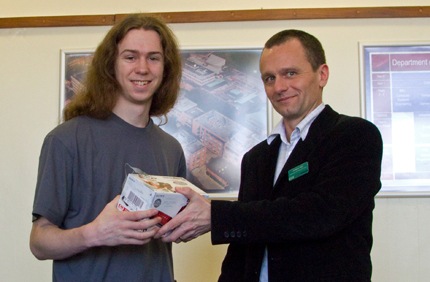
Head of department Warren (on the right) hands out the PSP 300 to Francis.
If you came along to see us, thank you, I hope you found the visit worthwhile.
You’ve probably heard me go on about I M Wright before. He is the “Microsoft Development Manager at Large” alter ego of Eric Brechner. He wrote the book Hard Code, which is a wonderful look at how to create software properly. He also has a blog which is brilliant. And now he has a podcast too, so you can listen to the good word rather than have to read it. You can find the file here.
Our union building has these fancy lights on the front that change colour. I couldn’t resist taking a picture of them from the car park tonight.

I was giving a talk to the .NET Masters students today about starting a project and I made a statement I’m quite proud of:
“Every time you make an assumption, somewhere a specification fairy dies”.
With apologies to Peter Pan.

At Hull we have fishes in the pavement.
For no particular reason we went for a walk around Hull Museums Quarter today. Makes a change from buying stuff up town, and I had a camera I wanted to play with. If you live in Hull and you haven’t been down there for a look round, shame on you. I’ve always liked looking around these places, and there are some quite nice bits and bobs in the Transport museum

It might have had “One Careful Owner”, but what about all the other ones?

I’ll have the oats please…
I’ve been watching videos during my lunch breaks over the last few days. This one is really superb. Very interesting if you are not sure what Computer Science is about.

The answer, by the way, is everything.
Some time back we got a colour laser printer. The price was amazing (cheaper than the first 9 pin dot matrix I ever bought) and we got a free set of toner cartridges too. The machine (a Samsung CLP-300) worked fine when we got it, and I thought that was that.
I was wrong.
It no longer feeds the paper in properly. The paper gets so far and then it sticks. Very annoying (a tip for printer buyers, do a search for “printername paper jam” before you buy one, just in case you get loads of hits. You do with the CLP-300…).
Anyhoo, I did some more searching and came across FixYa at http://www.fixya.com/. These people serve as collectors of self help tips for hardware owners, and there were quite a few threads about my printer, including one that said the springs in the paper tray were a bit under specified. These push the paper up against the first roller on the way into the machine, and get weak over time, leading to paper jams. The suggestion was to find some stronger springs.
Unfortunately my local spring emporium was shut for the night, and so I was forced to improvise. Turns out that a length of bubble wrap (unpopped works best) rolled into a cylinder and forced underneath the tray provides just enough extra spring power to make the printer work a treat. I’m not sure how long it will last, so I’d probably better get some springs at some point, but at the moment it works fine.
The GigaPan is a device that will let you take huge panoramic pictures using an ordinary digital camera:

I really like that kind of picture, so getting one might be a nice idea. But I think it would be even more fun to try and make one out of Lego. On the other hand, if you have 400 dollars to spare you can find out more here.
http://gigapansystems.com/system-page.html
Doh! Some one has beaten me to the idea.

The car park, on arrival today
Yesterday I finished the PS3 game Uncharted. Only started playing it in October last year. Go me. If you’ve not played the game I can strongly recommend it. Very much in the Tomb Raider mould, with some great level designs.
I’ve now moved on to Valkyria Chronicles from Sega. Number one son bought a copy whilst he was with us at Christmas, and since it was a good price I bought it a couple of weeks back. It is a turn based strategy game, a bit like the Advance Wars games that are so good on the Nintendo handhelds, but with lots of personality, a strong storyline and fantastic graphics. You get to hand pick, train and equip your troops before going off to fight against the Imperial forces (I was wondering if Imperial forces have always been the bad guys, perhaps it started with Star Wars).
The game itself has a very strong moral theme, starting with just how horrible war itself is, with picture postcard villages reduced to mud and wreckage before your eyes, and normal people dragged into the fight.
I’m enjoying playing it, except for one thing. If you are not careful some of your comrades in arms get shot. I hate this bit. Fortunately you can get them treated and evacuated from the battlefield, and I’ve not lost anyone permanently yet, but it is starting to worry me that I might in the future. I know that they don’t exist, and that the whole thing is actually a block of data running inside an unfeeling lump of hardware, but it still bothers me.
Went to York today and took some photos.

This is my new desktop background.
If you want to rediscover the joys of writing little programs and doing fun things with computers you could take a look at SmallBasic. It is inspired by the tiny Basic interpreters that you used to get with your Commodore 64 or BBC micro and lets you write programs using a very simple language in a friendly IDE.
I’m a great believer in starting to program by keeping your focus on the algorithms and things like this can only be good. Although I’m not sure about the Goto statement figuring quite so large....
Alfred Thompson had a good post in his blog about software testing. Alfred and I are around the same generation (I hope he won’t mind me saying this) and we’ve both written software for money in the past. When I was writing my largest projects I didn’t make use of any kind of tester particularly, I just make sure that it worked before I handed it over. Alfred was the same.
Nowadays it seems that there is a trend towards developers handing stuff over which they haven’t really tested, on the basis that the test people who receive it will find any mistakes they made. Alfred (and I) hate this idea. I put quite a verbose response to this effect on his post you can find here:
http://blogs.msdn.com/alfredth/archive/2009/01/27/how-not-to-develop-software.aspx
I’ve since talked to people in the business and was appalled to hear that this practice is not uncommon nowadays because developers are pushed to meet deadlines and the only way they can do this is by skimping on the testing they do. Ugh. I reckon this really goes back to Bad Management, in that a manager will get a good feeling if they are enforcing a strict regime with tight deadlines which the programmers are all hitting.
The end result though is that the testers keep sending stuff back for re-working because it has bugs in, the developers lose time on the next phase because they have to fix all these bugs, so they send the next version out (in time for the deadline) with more bugs and so on. The words Vicious and Circle spring to mind. Along with Bad and Product.
It turns out that one of my heroes, Eric Brechner, has written a lovely post about this that sets it out really nicely:
http://blogs.msdn.com/eric_brechner/archive/2009/01/01/sustained-engineering-idiocy.aspx
I have just received a nicely printed document called “Developing the Future” from Allison at Microsoft UK Academic Alliance. This is a summary of a report produced by the British Computer Society, software firm Intellect and Microsoft. The report is produced every year and takes a look at the way the UK Software Industry is going. If you are interested in the business I strongly suggest that you take a look at the summary. It makes lots of good points about the future. The full report is even more interesting (but is also 128 pages). Points that I took away were:
I read this with my “Hull University, Department of Computer Science” hat on of course, and I like to think that the graduates we produce are useful and have good employment prospects. Past experience seems to bear this out, and (not wishing to blow our own trumpet or anything) the fact that we are presently ranked sixth in the country for graduate employment bodes well.
You can get the summary, and the full report from here:
http://www.microsoft.com/uk/developingthefuture/default.mspx
I used to have a little Polaroid camera. I loved the way that the pictures appeared over time, and the strange way it had with colours. Nowadays such technology is being replaced by digital, but the Poladroid application does give you a way to recapture that old magic. It takes pictures and gives them the Polaroid treatment, right down to the borders and the way that they take time to appear. You can actually watch the image develop, and even take snapshots of the slowly appearing picture.
You can get the application from: http://www.poladroid.net/


A couple of snaps which have been converted.
Great fun.
Then again, Polaroid might be making a comeback:
I thought I was going to have to spend this evening rebuilding my machine. Just because I installed the new IE8 Release Candidate 1. It didn’t go well at the start:
I’d advise you to take a look at IE8. I’m sure you won’t have the fun and games that I’ve had. I’ve done some searching and nobody else has had problems like mine (do they ever..) It must be something funny about my machine that upset things at the start. You can find IE8 at: www.microsoft.com/ie8
And I even managed to sort out the timetable problem too.
Ha. It is the campus network which is causing the problems. I've reported the fault with IE (it must be something to do with IntraNet and InterNet settings, but I need extra information from the server to find out what) and dropped back to Ye Olde Messenger 8.1, which seems to work OK.
The smartest thing I did last year was to give something away. The result of putting the "Famous Yellow C# book" up on the blog has been a huge increase in traffic and thousands of downloads over the last few months.
Loads of people have been in touch saying how useful it has been to them. A number of courses are using it as one of their texts and it has even made its way onto the digital bookshelf of some leading software manufacturers. And of course quite a few new typos have been discovered....
I got a query today from someone who is moving from Java to C# and I remembered that some time ago I wrote some notes about this. I put them up on this site ages ago, but I've tidied the text up, converted it to pdf and put it in a coloured cover (this time orange). You can find the new material alongside the Yellow book on the same site:
I've made some tiny changes to the text, and fixed some typos. It never looks good if you get the words wrong in the introduction.....
Microsoft Tag is a new way you can put out links to web sites or whatever. The links are printed as patterns a bit like bar codes which you can read with your mobile phone camera. They use a cunning colour technology which means that even when they are snapped out of focus they can still be resolved into a readable address.

The tag for this blog.
The tags are linked through the Microsoft Tag site, which means that you can put expiry dates in them and the use of your tags is automatically logged so you can get reports on how much they are being used.
There are reader programs for most Smartphones including Windows Mobile, J2ME, iPhone, Blackberry and Symbian S60 devices. To work the phone needs a camera and of course internet access.
I'm thinking that when paired with a Polaroid PoGo printer, which prints sticky coloured prints just the right size for some text and a tag, this would be a very neat solution. I'm thinking about having a Tag treasure hunt at the next departmental bash. You can find out more about Microsoft Tag here.
Rob Miles is technology author and educator who spent many years as a lecturer in Computer Science at the University of Hull. He is also a Microsoft Developer Technologies MVP. He is into technology, teaching and photography. He is the author of the World Famous C# Yellow Book and almost as handsome as he thinks he is.


