Kodak Professional DCS Pro 14n
/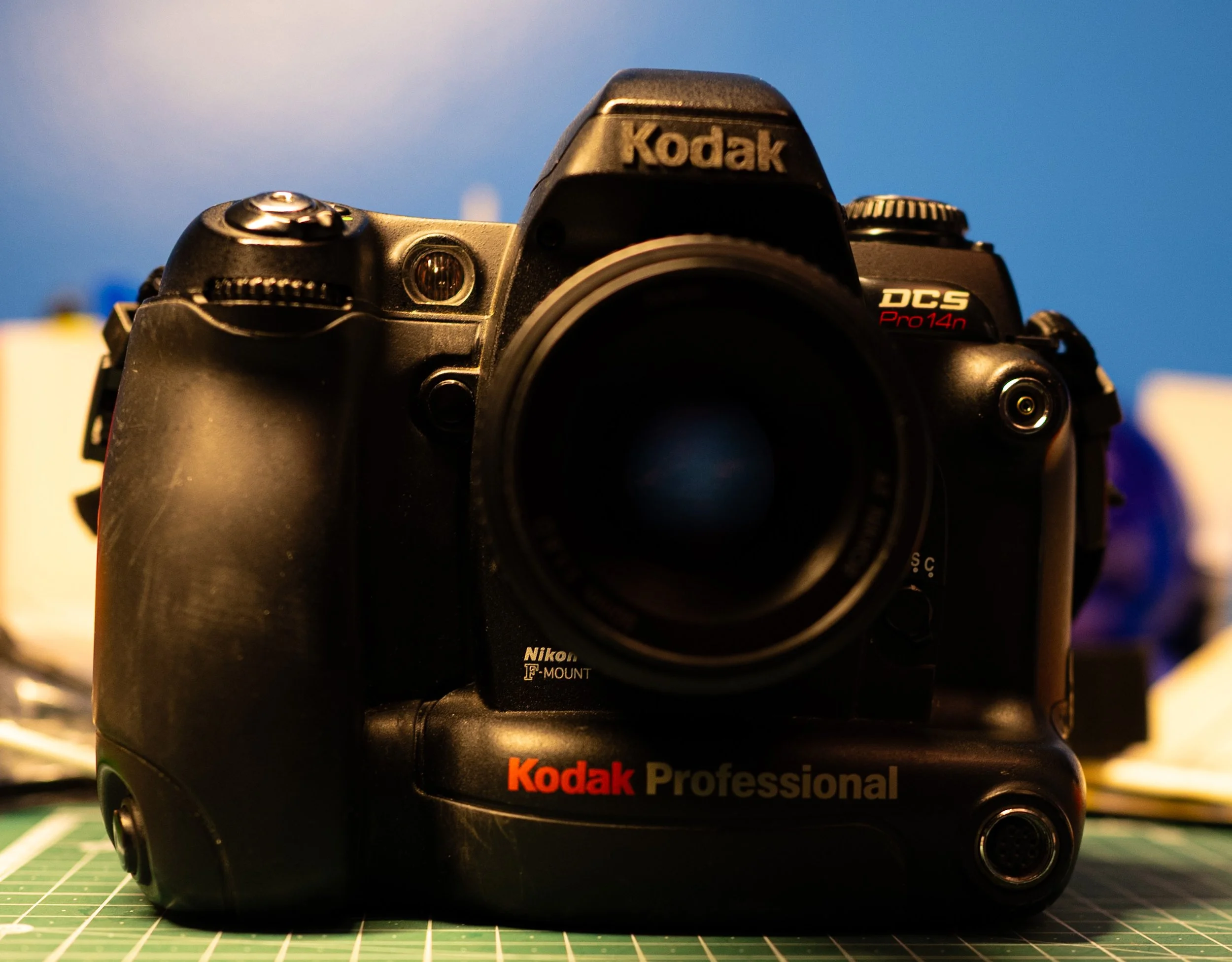
The Kodak Professional DCS Pro 14n is a bit of a landmark camera. It was released in 2002 when digital cameras were becoming a thing. The special thing about it is the full frame sensor. This makes the camera directly equivalent to the 35mm film cameras of the day. Professionals could use this with their existing Nikon lenses and have all the benefits of instant digital images. For only five thousand quid. You might not be surprised to discover it was not a great success. That’s not to say it is a bad camera. It takes really nice photos.


The camera can do a lot of tricks. The back is covered with buttons and there’s even a little additional text display which adds extra details of commands and lets you watch images being transferred to the two memory cards (Compact Flash and SD) that the camera supports. The photography bits are made by Nikon, which gives very solid auto focus, a great viewfinder and a great user experience. It even has an extra shutter button for use when taking portrait orientation photos. And a tiny built-in flash.
Why did I get one? Well, I wanted a bit of photographic history. And I wanted to find out how much digital photography has really come on over the years. If you want a full frame digital single lens reflex (SLR) there are much better, cheaper options that you can pick up. Ones that actually have things like spare batteries still available for sale. The Kodak is definitely an outlier. It is bulky and very slow to get going when powered on. It does have a few party tricks though. There is no anti-alias filter on the sensor. Most digital cameras have these. They spread the image over the multiple sensor sites to reduce fringing effects in pictures. They also increase blur. Leaving the filter out makes for sharper shots. The Kodak can also take pictures at stupidly low ISO values. This means you can make it a lot less sensitive to light and use large aperture lenses without messing around with extra filters. And I think it looks cool. I like using things with the word “Professional” on the front.
Should you get one? Almost certainly not. Batteries are hard to come by, it’s bulky to carry round. More modern cameras can match it for image quality, if not for old sensor dynamics. One thing to bear in mind. If you buying an old digital camera to add a bit of Charge Coupled Device (CCD) sensor magic to the red tones in your shots you should not get the Kodak. It was one of the first full frame cameras to use the Complementary Metal Oxide Silicon (CMOS) sensor design which is now used by all modern cameras. That said, the camera was set up to compete directly with the colour film of the day, and I reckon pictures from it look great. If you fancy a heavy and slow slice of history, by all means go for it.